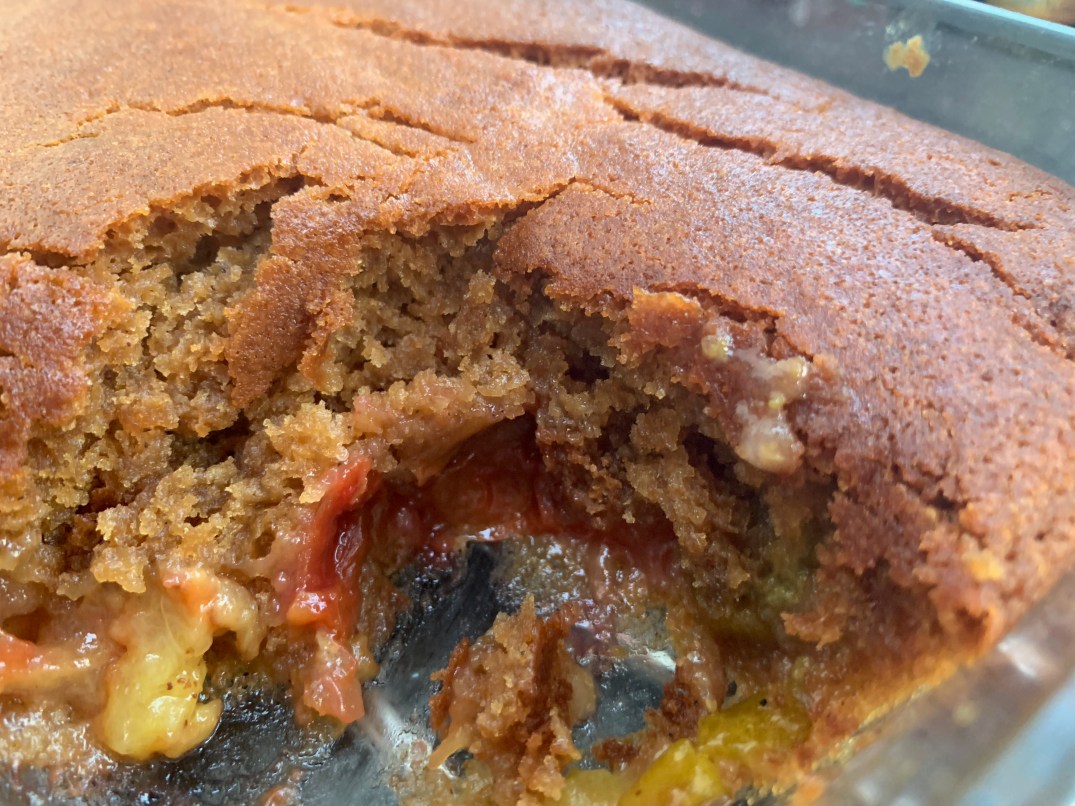
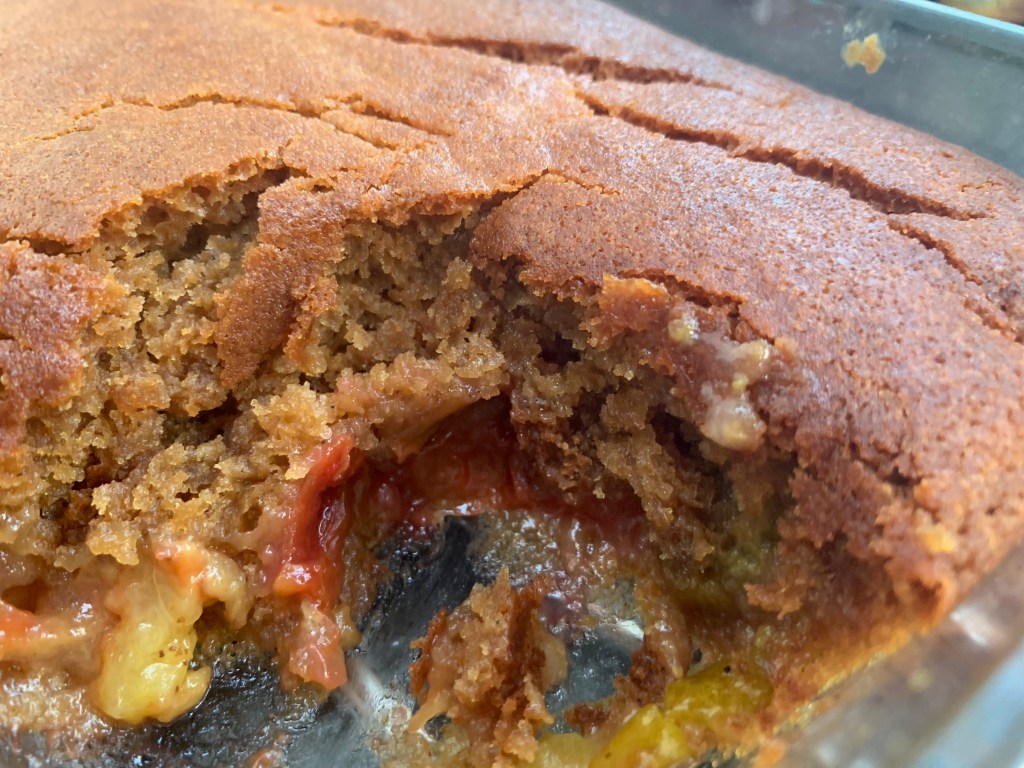
This is more of a pudding than a cake, but it is based on a recipe for cake that I devised to for my vegan, gluten and refined sugar free diet. I used a little more sugar than normal in this recipe to counterbalance the tartness of the plums and greengages. It is a really nice, comforting pud, great with a little vegan cream but equally good on its own.
Ingredients
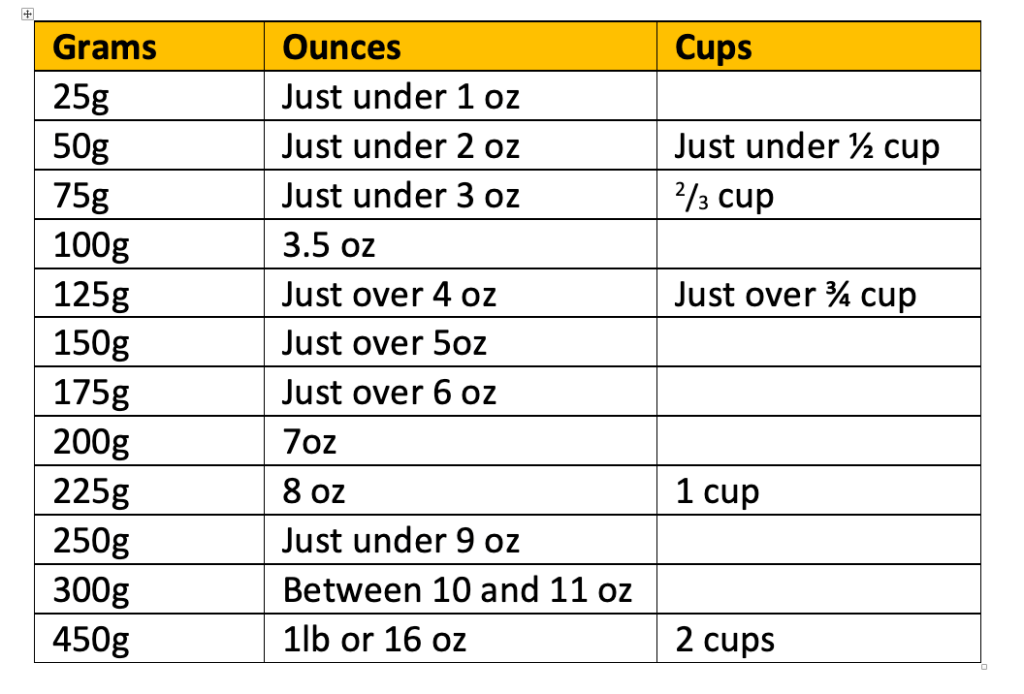
100g of coconut oil (in the heat of summer this will be liquid, in winter you may need to warm it over a saucepan of hot water as it works better liquid)
200g of gluten free self-raising flour (or plain flour with a teaspoon of gf baking powder)
100g of coconut palm sugar
50 ml of maple syrup
±140ml of soya milk (or for a more creamy taste soya cream)
1 teaspoon of vanilla powder, paste or essence
About a dozen plums
Method
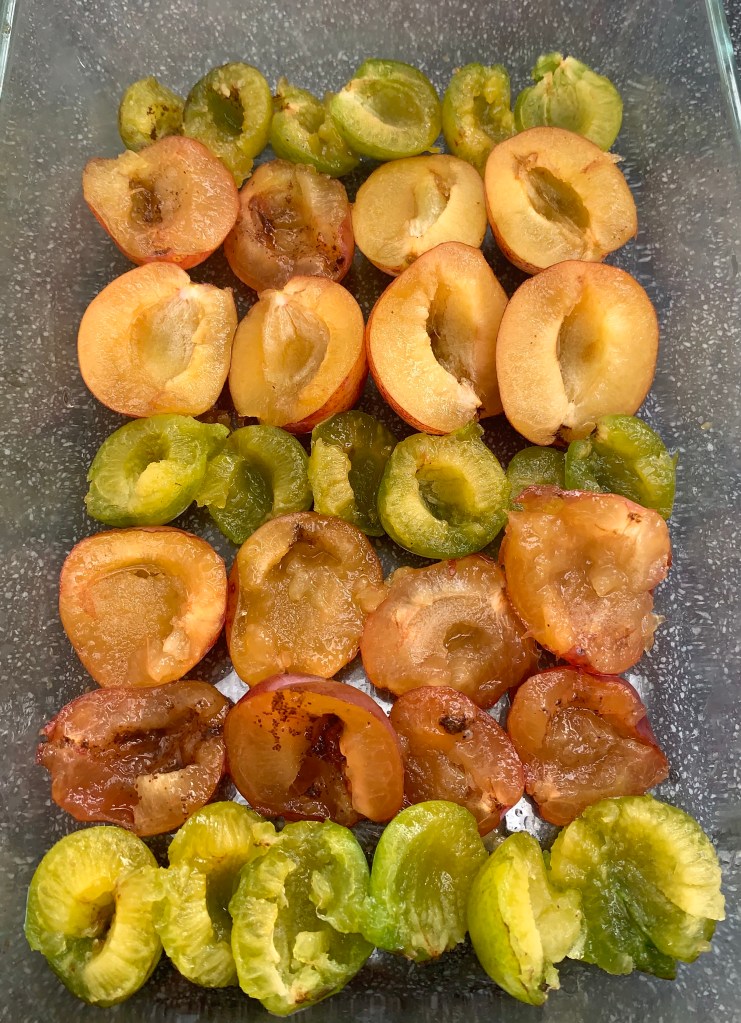
Cut plums, greengages (or any other fruit) in half and cover the bottom of a ceramic or glass baking dish
Put the coconut oil in a mixing bowl
Add in the flour, sugar and maple syrup
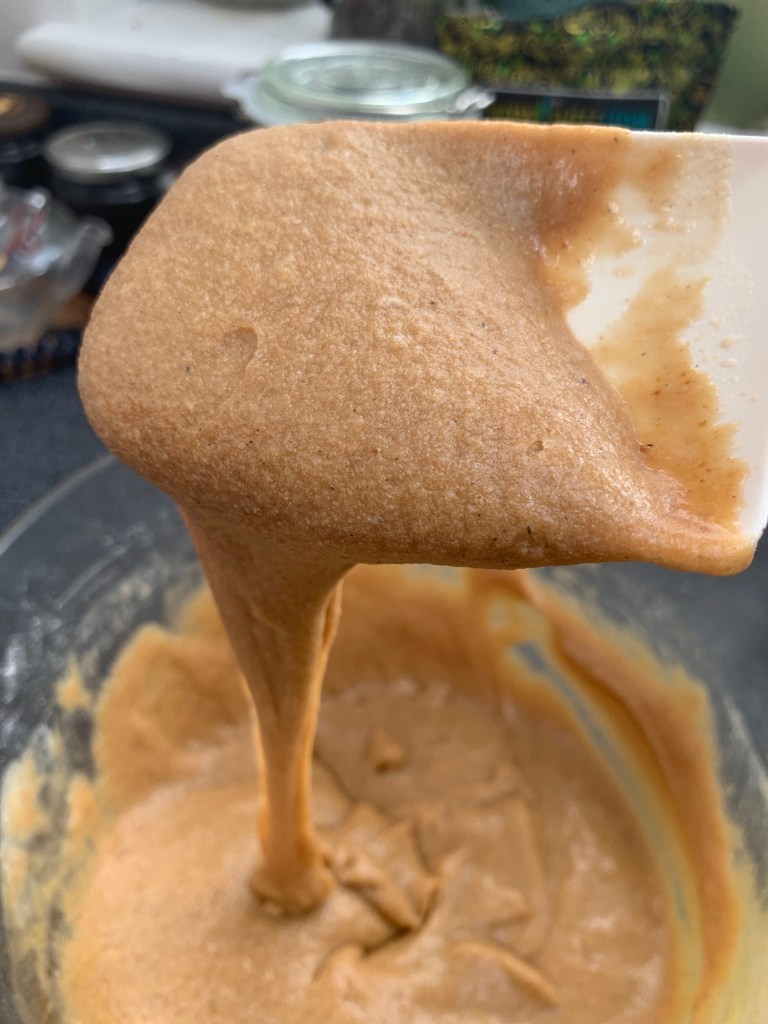
Add most of the soya milk mixing until your mix reaches dropping consistency
Leave the mix for a few minutes and you will find the flour absorbs moisture and the mix thickens
Add a little more soya milk to, once again achieve dropping consistency
Another post about foraging, a food blog was never my intention, but, heigh ho, it seems to be a theme right now so I am going with the flow. This week, for the first time ever, I cut and ate a bracket fungus, known as Chicken of the woods (proper name Laetiporus sulphureus). The tree on which it was growing was in the north of Milton Keynes. If anyone ever tells you MK is all concrete cows and roundabouts you might like to let them know that it is a city of 22 million trees and more to come. It has some wonderful green areas and it is possible to walk almost the entire length of the town through green space, following rivers or the canal.
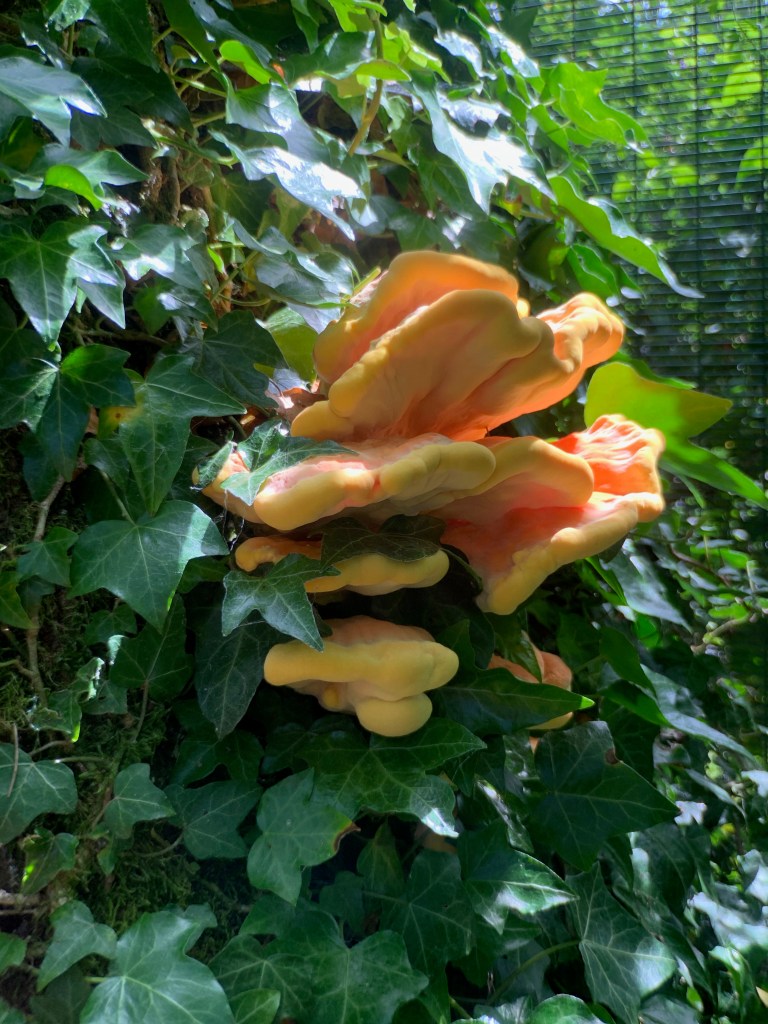
There were several outcrops of the fungus on the tree, this one was slightly higher than the one I chose to cut from but it shows the beautiful oranges and yellows of this mushroom
Hopefully in cutting the mushroom I did the right thing. I went armed with a sharpened knife and cut as close as I could to the trunk without damaging other parts of it. Someone else had been to the tree before me and had, by the look of it, taken an entire outcrop , but it was interesting to see that already new mushrooms were beginning to form, pushing their way through the hyphae where the cuts had been made.
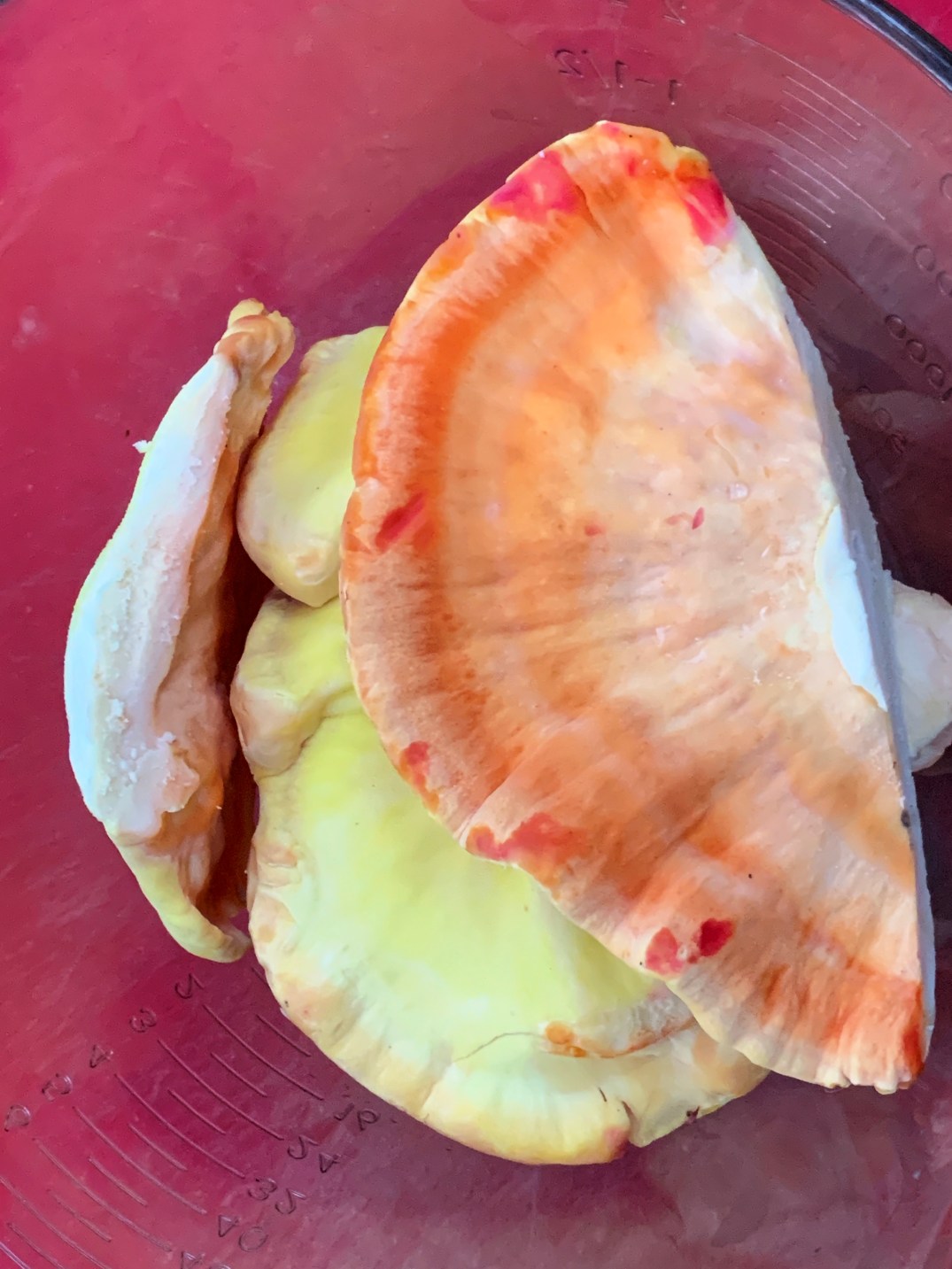
How did I know it was edible? A combination of internet research and my daughter and her boyfriend who are wild mushrooms lovers, helped me to have confidence that this was indeed Chicken of the woods and not something else. An important characteristic is the very beautiful lemon yellow gills on the underneath of the fungus. The picture below shows the delicacy of colour of the underside.
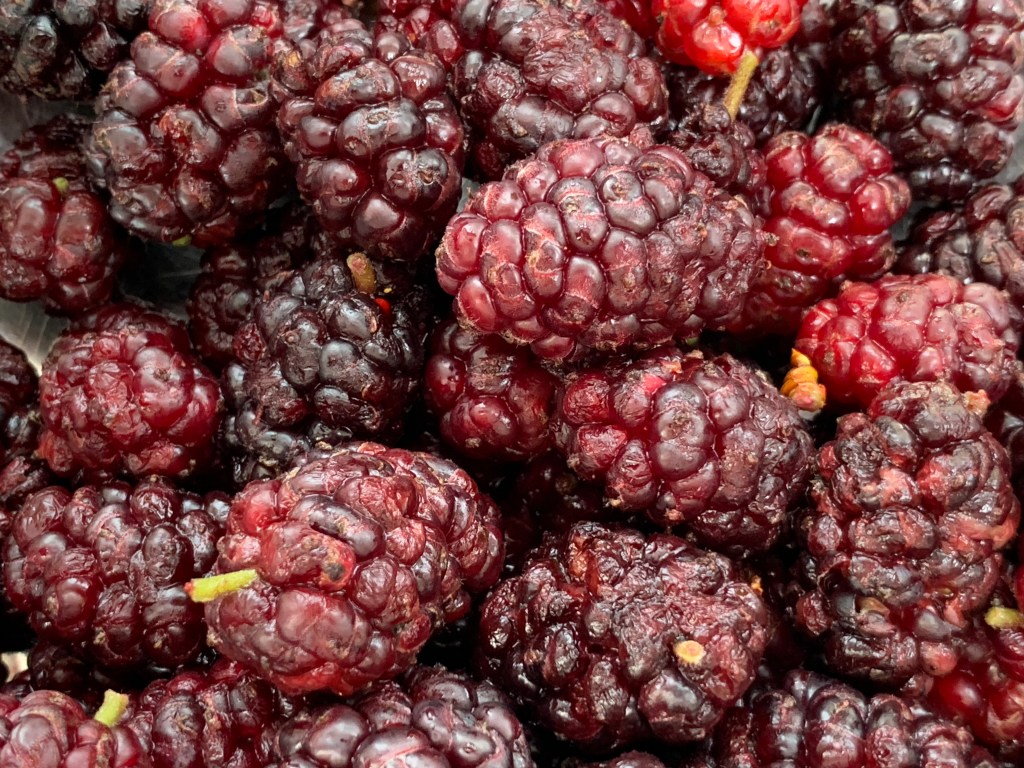
The cut mushroom before cooking, I think the red splodges are because I used a paper bag that had previously had mulberries in. I like using paper and cardboard containers for mushrooms, they sweat less than using plastic.
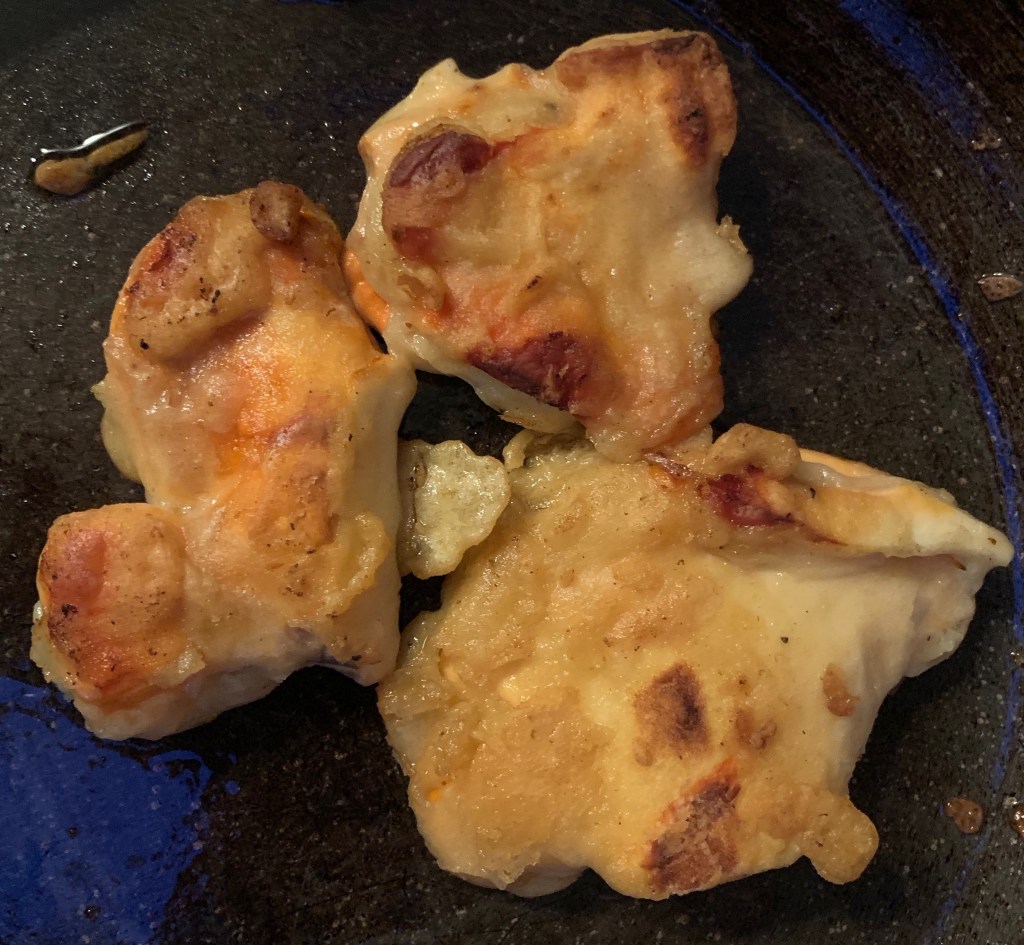
Having read a few recipes for the mushroom I decided to create something of my own and put together a batter of lemon juice, gluten-free flour, chickpea flour with a little water and a sprinkling of black pepper. I dunked the pieces of mushroom in this and shallow fried them.
Fried mushroom dipped in batter
I ate the mushrooms with roast potatoes, mashed sweet potato and a medley of vegetables in vegan cream which worked well. The fungus is delicious, it’s texture is astonishingly like chicken as I remember it (though I am an unreliable witness as it is a few decades since I ate it) and the taste is very similar too. I have future plans to try cooking it in a garlicky sauce which I think would work well.
I kept the pieces of mushroom that I did not cook in the fridge in their paper bag and a couple of days later sauted them in vegan butter so that I could freeze them. Word on the net is that it is better to do this than freeze them raw as they need to have less water in them to freeze without going flaccid. I tasted a little before they went in the freezer and they were really nice just plain, so I would be happy to eat them like that too.
I have to admit I was a little nervous about eating a foraged mushroom, but having done once so I will be looking out for this particular delicacy. I was quite controlled about how much I took, in my opinion taking only as much as you might use for a couple of meals seems fair, to enable everyone who wants to to have a share.
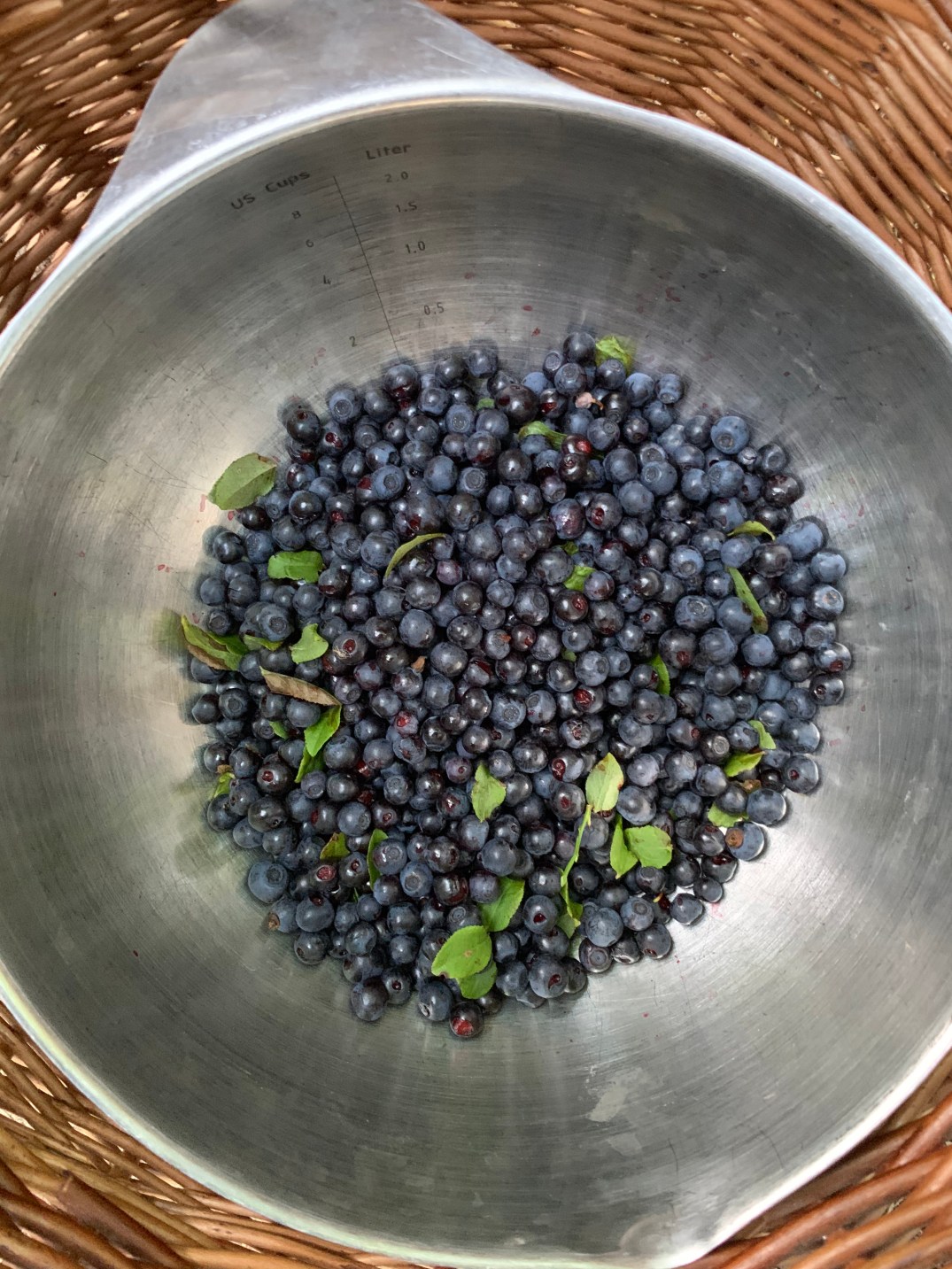
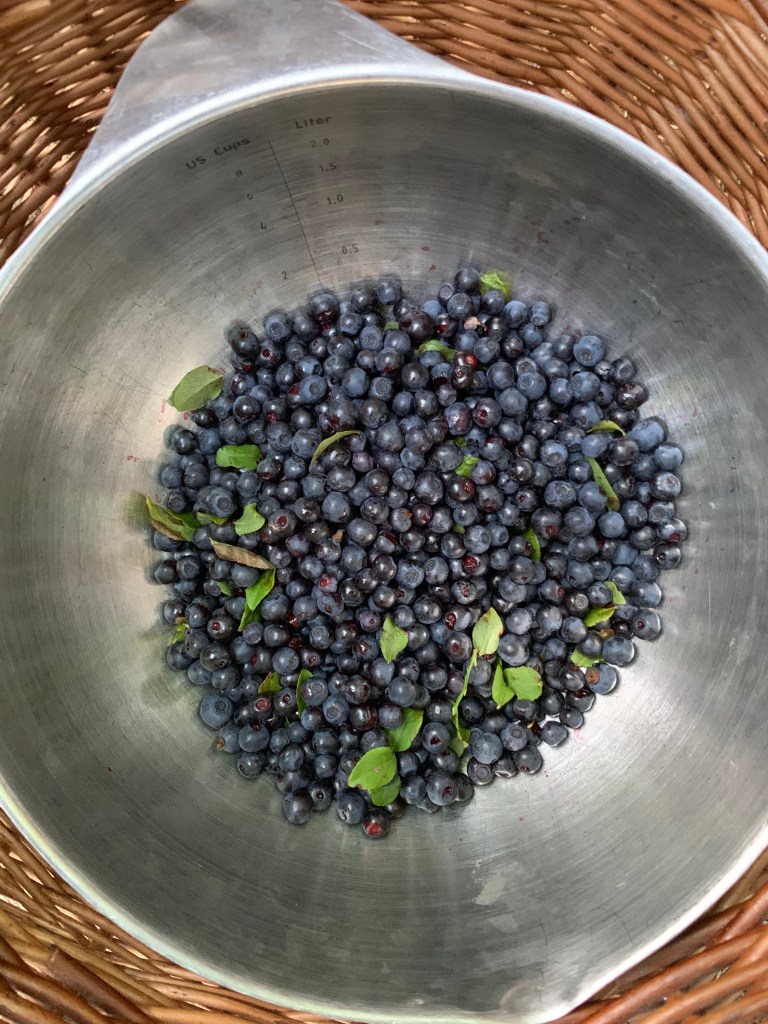
Late summer is a wonderful time in the UK. A walk in the countryside transforms into an opportunity to collect things to eat. On recent walks we have found bilberries in our local wood, blackberries in fields and, to huge delight, mulberries in what must be the remains of an old orchard, now overgrown, where a farm once stood. There are plums and greengages to be harvested from the orchard too when they are ready. On a recent trip to a wood some distance away, we found wild raspberries and saw cobnuts growing. My daughter recently found oyster mushrooms in the wild in the Lake District, she was brave enough to eat them and lives to tell the tale. Nature’s bounty is all around us if we just look.
Wild raspberries from the Ashridge Estate
There is something deeply satisfying about foraging, gathering your own food, perhaps it resonates with a deep instinct to do so, from those times when foraging was a necessity rather than a luxury afforded to those fortunate enough to have access to the green spaces where wild foods are found. But sadly, the other day, when I took a group of young teenagers for a walk in the woods, they were very wary of eating anything from the wild. Many people have become too used to food being boxed and packaged and only ok if bought in a supermarket, many of us have lost our connection to nature and our ability to read the world around us.
As my daughter and I picked fruit we realised that you only see what is there once you start looking for it, a bilberry bush which, at first glance only has a few berries turns out to have many more once your eyes have adjusted and you understand how the berries hide behind the leaves. Perhaps there is a lesson for us all in that – seek and you will find!
I was going to write something about whether cooking is an art or a science, but I see many others have done so before me. My view though is that creative cookery is more of an art, it is about blending colours and tastes smells and textures, to please all of the senses – even hearing, (think about pans sizzling or the crunching of carrots ). Like any art, it can be understood by science, ingredients can be quantified, their interactions with one another can be explained in scientific terms, the effects of heat or cold can be witnessed, but the alchemy of combinations is transcendent and ranks among all the other creative arts. It is of no surprise to me that, the designers that I work with are almost all good cooks, our bring and share lunches are always great, because they bring the same approach to food as they do to the creation of any other design. Importantly, creative cooking means trusting and following your intuition.
I was not popular with the teacher who taught ‘domestic science’ (later to be ‘home economics’) at school. I still remember the trauma of being forced to hold and gut a fish in a lesson. However, despite this, for as long as I can remember I have been cooking by intuition rather than following recipes to the letter. It is my belief that understanding your ingredients and what you are aiming for, helps you to be able to improvise and experiment and to create good food. The recipes on this site are all the result of experimentation, I don’t measure quantities when experimenting, and in order to pass these recipes on I have had to weigh things retrospectively. Passing on know-how rather than exact written instructions must have been how people have cooked, or indeed created anything, for many centuries.
Many of my non-cooking friends are scared of making a mistake when cooking or baking, and, my sense is that this fear stops them from ‘feeling’ what they are cooking. Although many recipes are great, there are often slight adjustments needed, a little more liquid for example or conversely something to absorb liquid. If you are able to develop a feel for how things should be then you can confidently make such adjustments. To become an intuitive cook though, like many other creative pursuits, means focusing entirely on the task in front of you rather than letting your hands do one thing while your head is elsewhere. It is this ‘getting in the zone’ that makes the difference between cooking being an enjoyable and relaxing way to spend time and it simply being a way to refuel. To develop this frame of mind it may help to note and appreciate the ingredients that you have in front of you, and maybe even think about where they have come from and how. When you cut vegetables look at their colour, their structure, when you blend ingredients look at the way they coalesce, when you cook or bake, observe the transformations that are taking place – treat cooking like a piece of performance art where you are spectator and the ingredients are the actors. Above all, give it time.
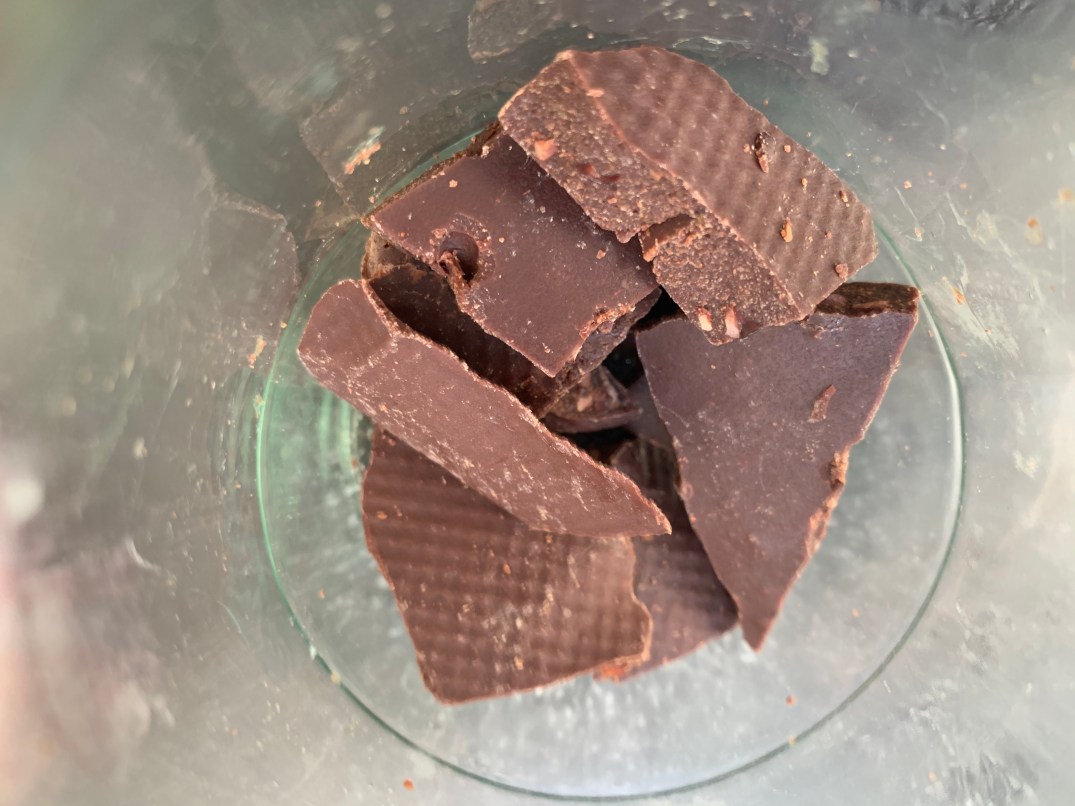
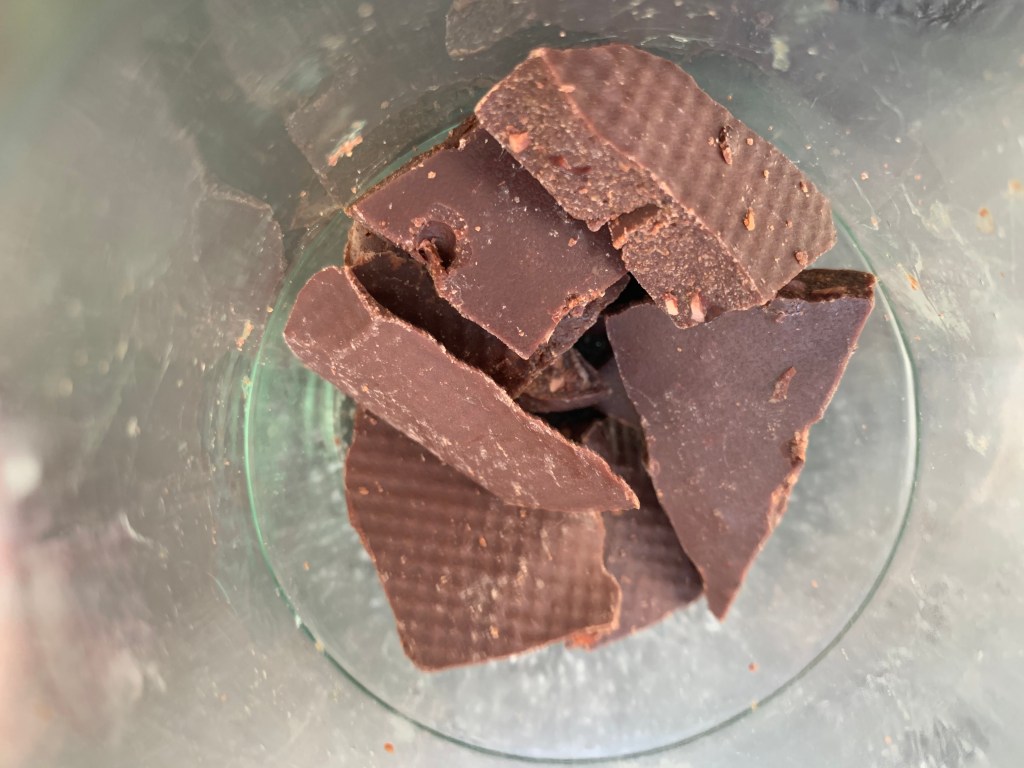
Weigh out the cacao paste, cacao butter and creamed coconut and put them all in a small glass bowl
Place the bowl over saucepan full of hot water (creating a Bain Marie) and keep stirring until all of the ingredients have melted. This will probably take less than 5 minutes.
When the mixture is liquid stir in the sugar and vanilla essence. The sugar may not all dissolve completely in the mix but stir for a few minutes to dissolve it as much as possible.
Add salt to taste – I use a salt grinder and do three or four twists
Add in the cacao nibs, if you like your chocolate crunchy put in more, if you prefer it smooth add less.
Either pour into a specially made chocolate mould or, like me, use a saucer lined with greaseproof paper.
You can set the chocolate quickly by placing it in the freezer, but the fridge works just as well.
It is best to keep the chocolate in the fridge as it has quite a low melting point. It is quite rich, so you won’t need much to satisfy your chocolate craving.
I came up with this recipe when I was trying to think of what to do with spinach from my veg box. It would works just as well with other leafy greens such as chard or even spring greens. This makes enough sauce for about 4 people.
Ingredients
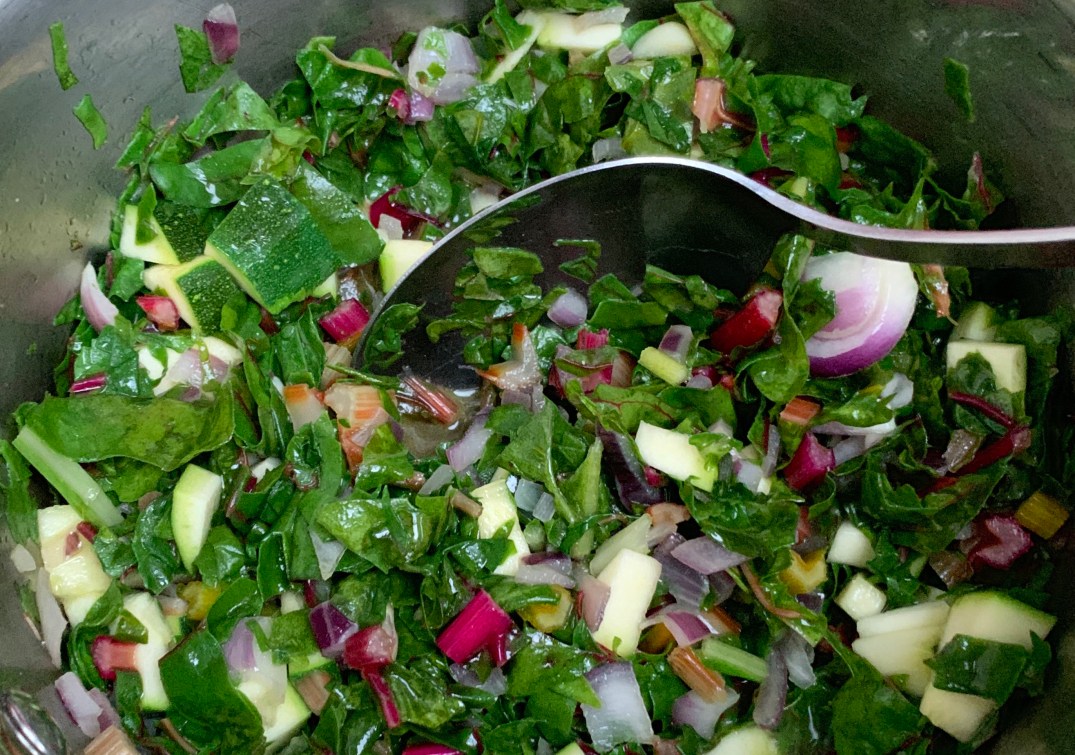
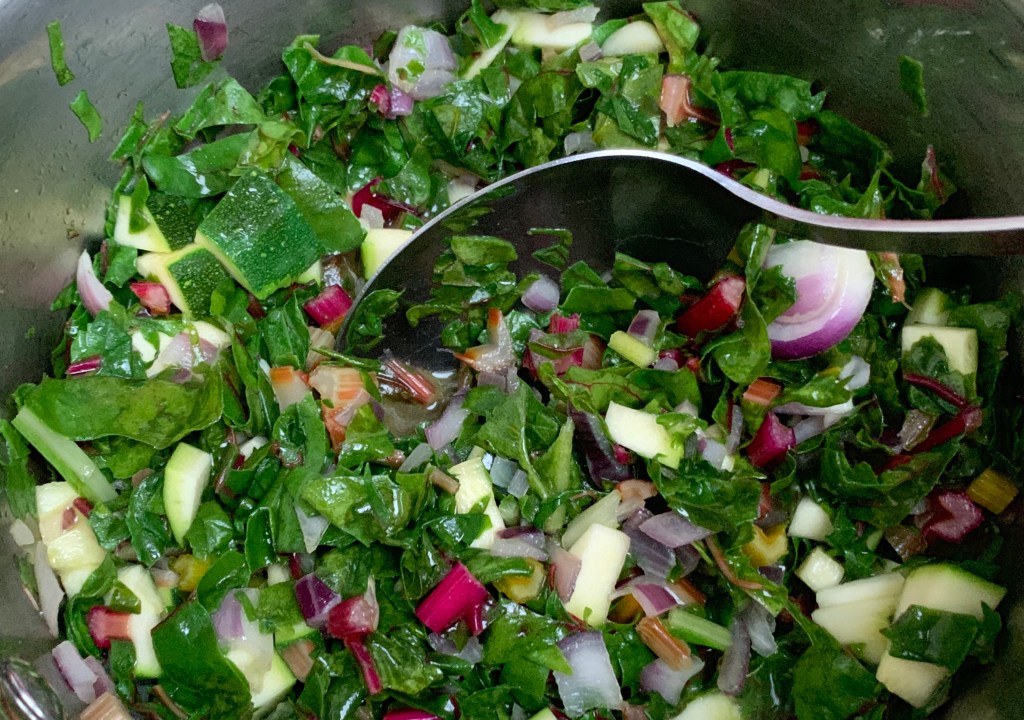
Making the pesto with rainbow chard and red onions
Medium sized onion
A whole small courgette or half a large courgette, diced into small chunks
Spinach – about 200g cut into small strips
Garlic to taste (a couple of cloves)
A handful of Pine nuts
Nutritional yeast flakes about a tablespoon full
A little vegan butter or olive oil
Seasoning (I just use pepper)
Method
1. Saute the onion and garlic gently in the butter
2. Add in the courgette diced into small pieces and cook for a few minutes
3. Add the spinach and cook till well wilted
4. Add the pine nuts and for a minute or two
5. Add the nutritional yeast flakes and seasoning as required
6. Blend the mix until it is a smooth, green, paste. if the mix is too thick add a little water or vegetable stock but this will probably not be necessary as spinach releases a lot of water when cooking.
7. Serve with gnocchi or pasta. Any left over sauce can be put into a jar and kept in the fridge for a few days.
So, chronologically I am pushing retirement age, mentally I am nowhere near ready to spend my life in garden centre coffee shops or shopping for beige cardis (though of course there is nothing wrong with either of those things). I love writing, in my day job I write a lot, but I am a lazy personal writer. This blog is my attempt to address that and to record some of the things that I have learnt along the way, possibly to share some of those thoughts that I have never got round to putting on paper, and maybe to share some of my creative work.
Although this feels a little like a vanity project I do hope that something somewhere is helpful or interesting to other people.



 Life Gathers